When it comes to ride-hailing vs ride-sharing, most people use the terms like they mean the same thing. They don't.
Here's the quick answer:
| Ride-hailing | Ride-sharing | |
|---|---|---|
| Who's in the car | Just you (and your group) | You plus strangers |
| Route | Direct to your destination | Multiple stops for other passengers |
| Cost | Higher, but predictable | Lower, but variable trip time |
| Best for | Airport runs, time-sensitive trips | Budget commutes, flexible schedules |
| Examples | UberX, Paxxy Ride | UberX Share, Lyft Shared |
Ride-hailing means you book a private driver who takes you directly where you need to go. Ride-sharing means you split a vehicle with other passengers heading in roughly the same direction, like on-demand carpooling.
Simple enough. But in practice, the lines get blurry fast.
Apps like Uber and Lyft offer both models under one roof, and they've historically marketed themselves as "rideshare" companies even when most of their trips are actually private rides. In July 2026, only about 35% of trips on these platforms are genuinely shared.
That confusion has real consequences for your wallet, your commute time, and even your environmental impact. This guide breaks it all down so you can make smarter choices every time you open a ride app in NYC.
To understand the modern transport landscape, we have to look past the marketing buzzwords. At its heart, ride-hailing is a digital upgrade to the traditional taxi model. When you use a ride-hailing service, you are hiring a private driver to transport you from point A to point B. The ride is yours alone. You control the climate, the music, and the route.
True ride-sharing, on the other hand, is closer to on-demand carpooling. Instead of booking an entire vehicle, you are booking a single seat. The platform uses complex routing technology to pair you with other passengers heading in the same direction.
According to industry terminology standards, confusing these two terms can create major headaches for both riders and business owners. A ride-hailing business is built around speed, convenience, and direct routes, while a true ride-sharing model relies heavily on passenger density and route overlap to remain viable. For a deeper look into how these concepts compare to traditional carpooling, you can explore this ride-hailing, ride-sharing, and carpooling comparison.
To visualize how these two trip types differ on the streets of New York, consider this route comparison:
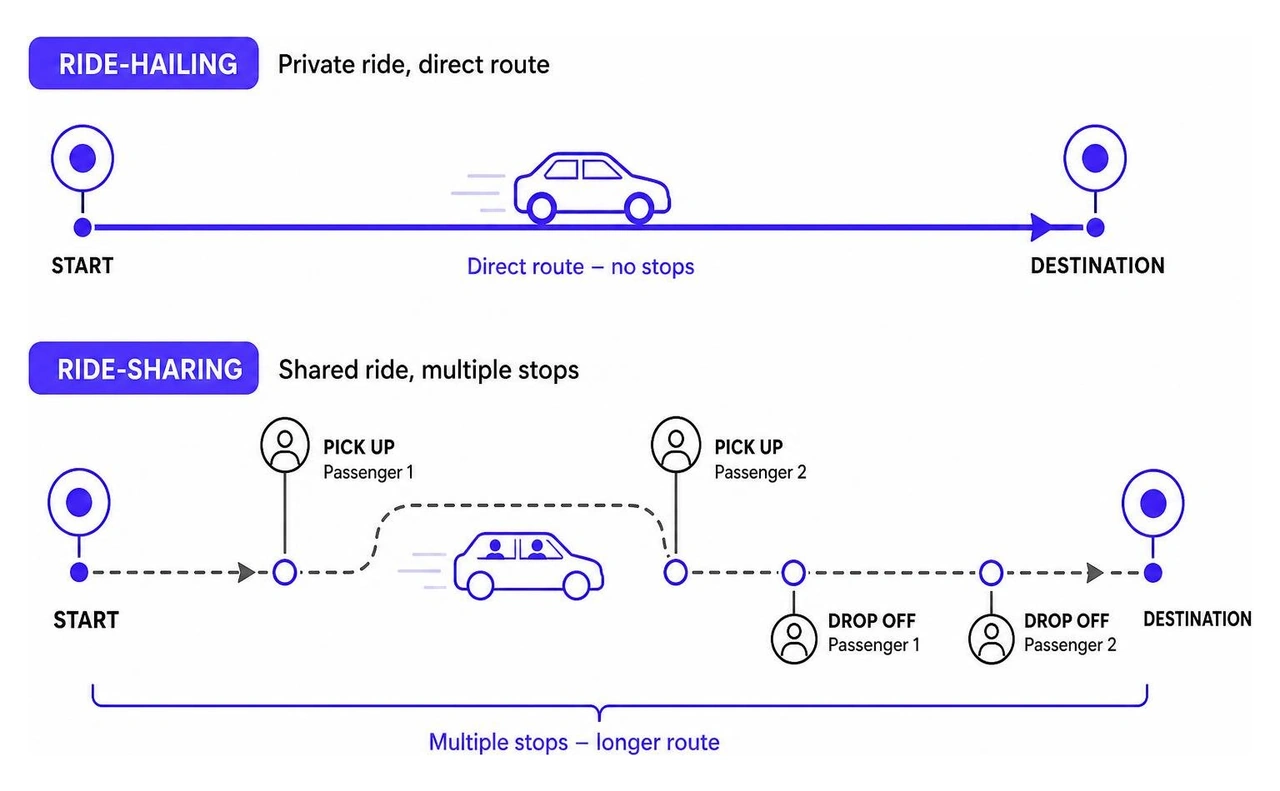
As shown in the diagram, ride-hailing provides a direct, uninterrupted line to your destination. Ride-sharing introduces detours, picking up and dropping off other commuters along the way. While this sharing of resources can lower the individual cost of the trip, it requires you to sacrifice control over your schedule.
The confusion between these terms did not happen by accident. When pioneers of the industry first launched in the early 2010s, they branded themselves as "ridesharing" platforms to bypass strict local taxi regulations. It sounded community-oriented, cooperative, and distinctly different from a traditional commercial car service.
Over time, "rideshare" became the generic industry shorthand for any app-based transportation. The evolution of ridesharing companies shows that while these platforms originally focused on peer-to-peer carpooling, they quickly shifted their primary business to private ride-hailing. Today, even when you book a private ride where you are the sole passenger, the media, the public, and even insurance companies still call it a "rideshare."
In New York City, the financial difference between ride-hailing and ride-sharing is shaped by unique local regulations, fees, and pricing algorithms.
When you book a private ride-hailing trip, you pay a premium for speed and privacy. However, on major platforms like Uber and Lyft, this base cost is highly volatile. Their dynamic pricing models trigger dramatic "surge pricing" during rush hours, sudden rainstorms, or subway delays. A trip from Forest Hills to midtown Manhattan that costs $30 at midday can easily skyrocket to $80 or more during peak hours.
Furthermore, New York City has strict congestion surcharges. For any trip starting, ending, or passing through Manhattan south of 61st Street, a congestion fee is added to the fare.
True ride-sharing options, like UberX Share, can be 20% to 50% cheaper than private rides because the cost of the vehicle, fuel, and driver time is divided among multiple riders. However, these savings come at a cost. If you are matched with co-riders, your trip will take longer. If you are running late for an important meeting in Queens, those extra fifteen minutes spent picking up a stranger can be incredibly expensive in terms of stress.
At Paxxy, we believe New York commuters deserve a better alternative. We do not offer shared rides that force you to take long detours with strangers. Instead, we focus on delivering affordable, high-quality private ride-hailing. By utilizing advanced AI-driven fair pricing, we keep our rates highly competitive and predictable. We bypass the extreme surge pricing models used by Uber and Lyft, ensuring that when you book a private Paxxy Ride, you get a direct, reliable journey that is significantly cheaper and without the shocking price tag.
The success of a shared ride depends entirely on the math behind it. Ride-sharing apps rely on complex pooling algorithms to match riders in real time. The algorithm must calculate the locations of multiple passengers, their destinations, current traffic conditions, and the optimal sequence of pickups and drop-offs.
When designed poorly, these algorithms fail to deliver a good user experience. If a detour takes you ten minutes out of your way to pick up a passenger who is only traveling three blocks, the system has failed. This is why many platforms have struggled to maintain their shared-ride offerings over the years. According to transit agency research on ride-sharing, true ride-sharing requires incredibly high passenger density and highly sophisticated scheduling software to prevent rider frustration. Without this precision, shared rides often default to operating as highly inefficient, glorified taxi services that disappoint both drivers and passengers.
One of the original promises of app-based transportation was that it would reduce traffic congestion and lower carbon emissions in major cities. The theory was simple: if more people shared rides, there would be fewer single-occupancy vehicles on the road.
Unfortunately, the reality in New York City has been quite different.
Instead of reducing traffic, the rapid growth of app-based travel has contributed to increased congestion on major arteries like the Queensboro Bridge and the Long Island Expressway. One of the main culprits is "dead mileage" (also known as deadheading). This refers to the miles a driver spends circling the block or driving to a pickup location without a passenger in the back seat. In busy areas of Queens and Manhattan, dead mileage can account for up to 40% of a driver's total time on the road, creating unnecessary emissions and filling up valuable street space.
Data shows that app-based rides do not always replace private car trips. In fact, research indicates that only about 20% of these trips replace personal car journeys. Another 20% replace traditional taxi services. The remaining 60% of trips actually replace sustainable options like public transit, biking, or walking, or represent trips that people would not have taken at all if the apps did not exist.
Because only 35% of nationwide trips on major platforms are shared, the vast majority of app-based travel operates as private ride-hailing. This means more individual cars on the road, higher carbon footprints, and slower traffic speeds across the five boroughs.
Because New York City has such a complex transportation network, the choice between ride-hailing and ride-sharing should depend entirely on your specific circumstances.

There are times when saving a few dollars by sharing a ride is simply not worth the risk. The most obvious scenario is airport transfers. If you are catching a flight out of JFK or LaGuardia, timing is everything.
When traveling from Forest Hills, Queens to JFK, a direct trip via private ride-hailing is highly predictable. If you choose a shared option, you might find yourself heading in the opposite direction first to pick up another passenger, turning a simple 20-minute trip into a stressful 50-minute race against the clock. For these high-stakes trips, booking a private vehicle is the only logical choice.
For these critical travel moments, we recommend utilizing Paxxy's dedicated ride services NYC. When you use Paxxy, you benefit from true real-time booking meaning that your driver is dispatched instantly, without the unpredictable wait times or detour risks associated with shared platforms. Paxxy offers a much cheaper and more reliable private ride compared to Uber and Lyft.
Shared rides are best suited for routine, low-stakes travel where your schedule is highly flexible. If you are meeting friends for dinner in Astoria on a casual weekend afternoon, or if you are commuting home from work with plenty of time to spare, sharing a ride can be an excellent way to save money.
If you are looking for ways to navigate the city on a budget, it is helpful to understand what ride options are available across different platforms so you can select the perfect balance of cost and speed for your day.
In New York City, passenger safety and driver standards are strictly regulated by the Taxi and Limousine Commission (TLC). Unlike other parts of the country where ride-hailing drivers can operate with standard personal auto insurance and basic background checks, NYC requires all drivers to hold a professional TLC license.
This means that whether you book a private ride or a shared trip, your driver has undergone:
The regulatory landscape in July 2026 continues to evolve around driver classification. While major platforms like Uber and Lyft have faced ongoing legal battles regarding whether drivers should be classified as independent contractors or employees, the TLC maintains strict oversight to ensure fair pay and safety standards for all NYC drivers.
At Paxxy, we are proud to be a fully TLC-licensed platform. Every single driver in our network is a fully vetted professional operating a licensed commercial vehicle. We believe that keeping our drivers happy through fair compensation directly translates to a safer, cleaner, and more professional experience for our passengers.
Uber is a hybrid platform that offers both services. Standard options like UberX, Uber Black, and UberXL are ride-hailing services because you are hiring a private vehicle for your exclusive use. UberX Share (formerly known as Uber Pool) is a true ride-sharing service because it matches you with other passengers to share the vehicle and split the cost.
If you want a guaranteed private ride without the high corporate markups of Uber, Paxxy is the perfect dedicated ride-hailing alternative, offering premium private rides at highly competitive rates.
While traditional yellow taxis can now be summoned via local apps, modern ride-hailing applications offer several distinct advantages. A dedicated ride-hailing application like Paxxy provides upfront pricing, real-time GPS tracking of your approaching vehicle, automatic digital payments, and detailed driver ratings. This eliminates the guesswork of metered fares and provides a highly transparent, reliable experience.
When booking rides in NYC, the price you see on the screen can sometimes include hidden surcharges. These can include:
When you learn how do I request a ride with Paxxy, you will find that our booking process is completely transparent. We display your exact fare upfront, utilizing our AI-driven pricing model to avoid unexpected surcharges and hidden fees.
Understanding the difference between ride-hailing vs ride-sharing is the key to navigating New York City efficiently. If you have a flexible schedule and want to minimize your transit costs, shared ride-sharing can be a helpful tool. But when you need speed, privacy, and absolute reliability, private ride-hailing is the gold standard.
At Paxxy, we have designed a premium ride-hailing experience specifically for New Yorkers. We do not make you share your ride with strangers or take frustrating detours. Instead, we focus on delivering top-tier, private transportation across our five official service tiers:
With fully TLC-licensed drivers, 24/7 availability, and our innovative AI-driven fair pricing model, we provide a safer, more reliable, and more affordable alternative to Uber and Lyft.
Ready to experience a better way to move through NYC? Explore our full range of Paxxy services today.
Download the Paxxy app on the App Store or Google Play, and take 40% OFF your first 3 rides with the promo code WELCOME26. Your clean, private, and professional ride is just a tap away!
.gif)
Every detail is designed around your comfort and safety.